
port
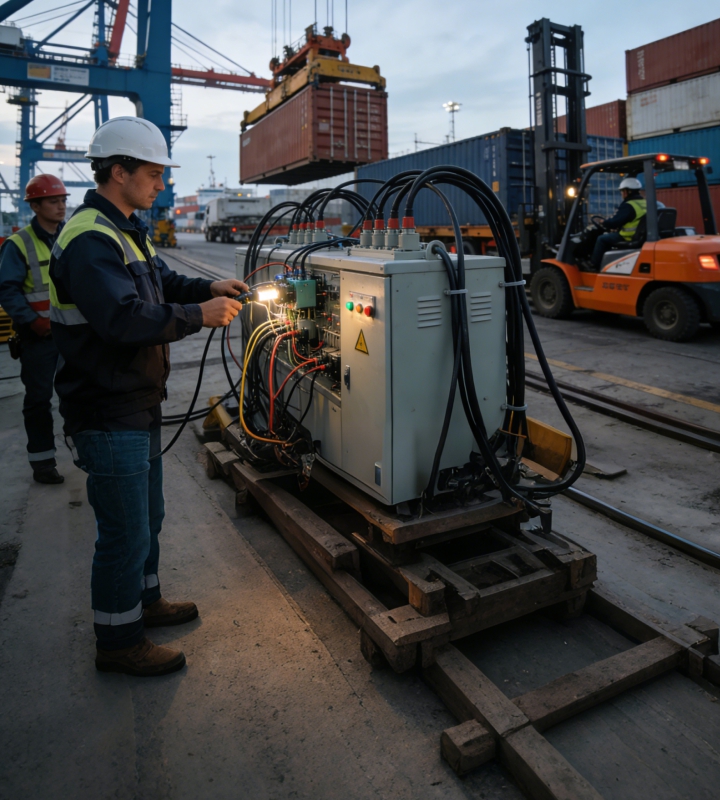
Industrial waterproof plugs serve as core components of electrical systems at ports and terminals; their primary function is to provide safe, reliable, and uninterrupted power connections to various types of equipment within harsh environments characterized by high humidity, intense salt spray, and severe vibration.
I. Core Application Scenarios
1. Refrigerated Container (Reefer) Power Supply (The Primary Scenario)
Function: To provide continuous power to refrigerated containers within terminal yards, thereby maintaining the low-temperature environment required for their cargo (e.g., fresh produce, pharmaceuticals).
Specifications: The mainstream specifications are 4-pole, 380V, and 32A/63A, in compliance with international shipping standards.
Requirements: Must meet an IP67 or higher protection rating and possess salt-spray resistance and anti-vibration capabilities to ensure zero-interruption operation of the refrigeration units.
2. Power Supply for Mobile Port Handling Equipment
Equipment: Gantry cranes, quay cranes, reach stackers, container handlers, buried scraper conveyors, etc.
Features: Equipment requires rapid intermittent movement and covers a large operational area; necessitates plug-and-play interfaces for temporary or mobile power connections.
Specifications: Typically 4-pole, rated at 63A or 125A; IP67 immersion-proof rating; equipped with mechanical interlocks to prevent accidental disconnection.
3. Fixed Terminal Facilities and DC Power Supply
Scenarios: Terminal lighting, water pumps, conveyor systems, maintenance workshops, and temporary power distribution boxes.
Function: Provides convenient and safe power access for electric welders, power tools, and similar equipment.
Configuration: Installation of waterproof junction boxes along the terminal shoreline and within the container yard, housing multiple sets of industrial-grade waterproof power outlets.
4. Intelligent Port Automation Equipment
Applications: Charging and data interfaces for AGVs (Automated Guided Vehicles), unmanned straddle carriers, and intelligent cargo tallying systems.
Trends: Adoption of waterproof, quick-connect, and hybrid signal-power connectors to facilitate integrated high-current fast charging and data transmission.
II. Specific Environmental Requirements for Ports
Ports constitute one of the most demanding environments globally for electrical applications; consequently, waterproof plugs utilized in this setting must meet the following stringent criteria:
High Protection Rating: Must meet or exceed IP67 standards, providing protection against immersion and splashing from sea waves.
Superior Corrosion Resistance: Capable of withstanding salt spray, sea breezes, and high humidity. Housings typically utilize 316L stainless steel or weather-resistant engineering plastics; contacts are gold-plated, and sealing rings are constructed from fluororubber or silicone rubber.
Vibration Resistance and Mechanical Strength: Designed to withstand operational vibrations from equipment, vehicular loads (including heavy vehicles), and the impact of typhoons. Units must pass IEC 60068 vibration tests and feature anti-loosening, high-security locking mechanisms.
Wide Operating Temperature Range: Capable of functioning reliably across extreme temperature variations, ranging from -40°C to +70°C.
Anti-Mismating Design: Employs the color-coding and "clock-positioning" keying system defined by the IEC 60309 standard to prevent the accidental interconnection of plugs with differing voltage ratings or pole configurations.
High Current-Carrying Capacity:Capable of meeting the power demands of high-output equipment; common specifications include 32A, 63A, and 125A.
nstallation and Maintenance
Utilize waterproof cable glands to ensure a watertight seal at the cable entry point.
Periodically (every 3 to 6 months) inspect the sealing rings; clean away any accumulated salt deposits or debris to prevent seal failure.
Any unused or disconnected interfaces must be fitted with a protective waterproof and dustproof cap.
III. Value and Benefits
Ensure Production Continuity: Minimizes downtime for refrigerated containers and equipment stoppages caused by electrical faults, reducing the power interruption rate to below 0.02%.
Enhance Safety:Completely eliminates the risks of leakage, short circuits, and electric shock in humid or salt-mist environments.
Reduce O&M Costs:Features a highly durable design (with a service life exceeding 8 years), significantly reducing the frequency of replacements and maintenance.
Adhere to International Standards:Complies with international specifications such as IEC 60309, ensuring compatibility with global shipping equipment.